Jev AI: The Decision Model That Does Not Want to Talk to You
How TypeSafe's Jev challenges the LLM-first approach by turning unstructured context and typed questions into decisions software can use directly.
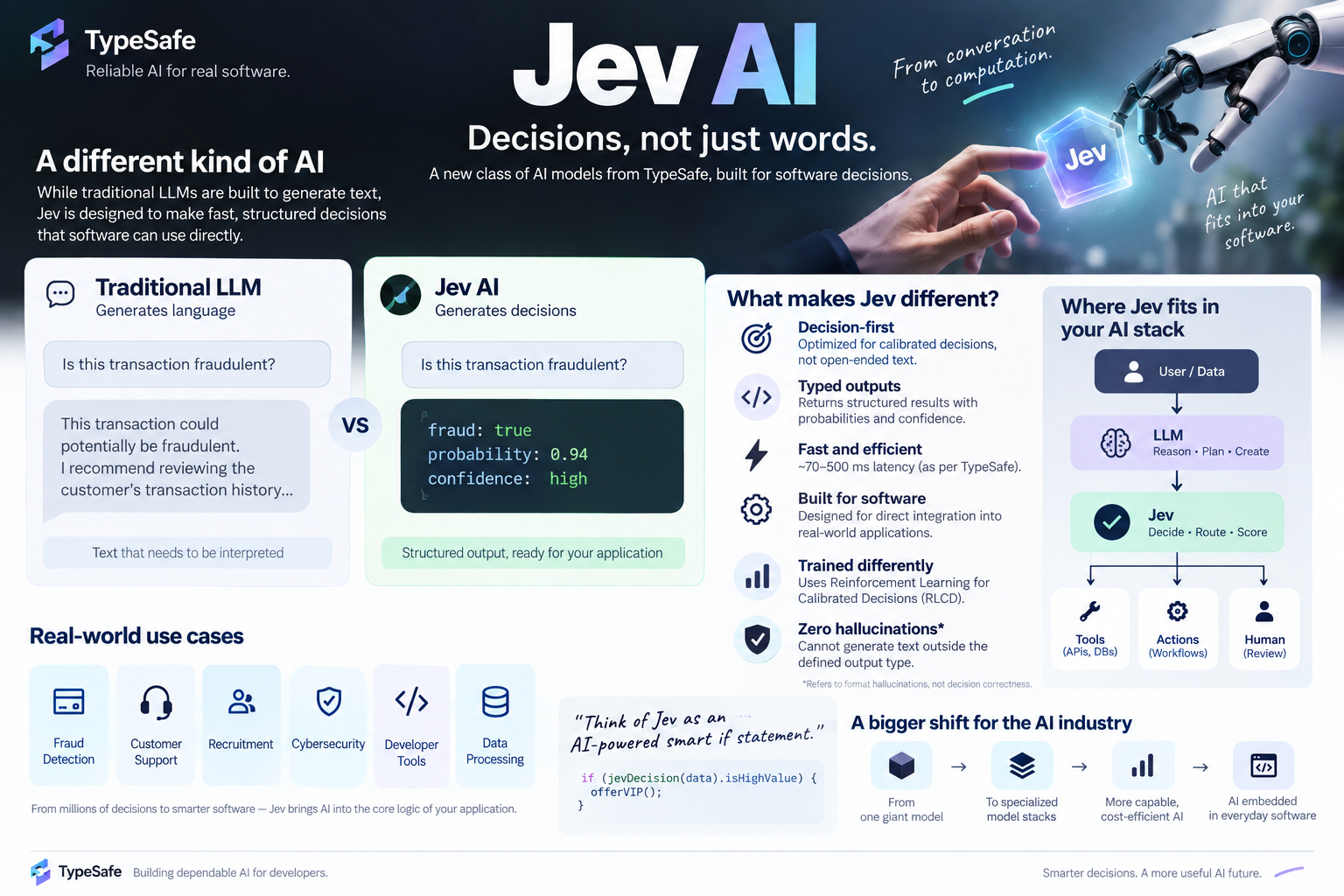
For the last few years, the dominant AI interface has looked like this: ask a question, let an AI generate text, then make software interpret the answer. ChatGPT, Claude, Gemini and other large language models made that interface remarkably powerful.
But software does not always need an essay. It often needs a small, actionable answer: should this request be approved, which workflow should run, is the transaction suspicious, or should an agent retry?
This is the problem TypeSafe is aiming at with Jev, its first public System One model. Introduced in September 2026, Jev is designed for fast, structured decisions that applications can consume without treating a paragraph as an API.
What is Jev AI?
Jev is not intended to be another ChatGPT. It is not optimized for writing articles, explaining programming concepts or maintaining an open-ended conversation. TypeSafe describes it as a model that takes unstructured state plus typed questions and returns typed decisions with probabilities and confidence.
For example, an e-commerce application could ask whether an unfamiliar card charge is potentially fraudulent. Instead of receiving a paragraph that must be parsed, the application could receive a constrained result such as:
fraud: trueprobability: 0.94confidence: high
The important idea is direct integration: no extracting JSON from prose, no asking a second model what the first model meant, and no accepting an answer outside the schema the application declared.
Jev AI vs. LLMs: decisions, not strings
Large language models are optimized to generate sequences of tokens. They can produce text, code, explanations and structured text, but the output is still generated language. Jev takes a different position in the stack: it is designed to return a decision from a defined answer space.
- LLM: reason, write, explain and generate.
- Jev: classify, route, score and decide.
- Traditional code: execute deterministic rules.
A typed question might define the possible response as approve, reject or review. The model is not being asked to invent a format; the software defines the output space in advance.
The key distinction
Structured output from an LLM asks a generative model to follow a schema. A decision model makes the schema part of the problem it is designed to solve. That can make uncertainty, validation and downstream automation easier to reason about.
Why not use JSON mode?
Modern LLMs can already return valid JSON, so this is a fair question. JSON mode improves formatting, but it does not necessarily change the model's underlying objective. An application may still be asking a general-purpose generator to behave like a low-latency decision engine.
Jev flips that relationship. The application defines choices, scores or boolean outcomes, and the model returns a typed decision with a probability or confidence signal. The promise is less about making AI magically correct and more about making its contract easier for software to consume.
What does “zero hallucination” mean here?
TypeSafe's “zero hallucination” claim needs careful context. If Jev can only return one of the values in a defined output type, it cannot drift into arbitrary prose or invent a field that the application did not request.
That does not mean Jev can never make a wrong decision. A model could return yes when the correct answer is no. Constrained output addresses format unpredictability, not the deeper question of model accuracy.
Production lesson: treat confidence as a signal to evaluate, not proof that a decision is correct. Calibration, edge-case testing and human review thresholds still matter.
Why decision models matter for AI agents
AI agents combine language models with tools, memory, planning, APIs, databases and code. In a customer-support workflow, an agent might need to understand a message, determine priority, choose a department, check account history, decide whether a refund is allowed and then call a payment API.
A large language model may be appropriate for understanding and writing. It may be unnecessary for every small routing or retry decision. A specialized decision layer could handle questions such as:
- Which agent or tool should handle this task?
- Should the workflow continue, pause or escalate?
- Should a failed action be retried?
- Does the output need human review?
- Is the request suspicious enough to trigger a guardrail?
This creates a hybrid AI architecture: the LLM handles reasoning and generation, while Jev handles the compact decisions that connect those capabilities to software.
From one giant model to a model stack
Production AI may increasingly ask “which model should handle this part of the workflow?” instead of “which single model is most powerful?” A real application could combine a generative LLM for planning and writing, a decision model for routing and scoring, and smaller detection or embedding models for classification and search.
This specialization could also lower cost and latency. Questions such as “is this spam?”, “is this lead qualified?” and “should this ticket be escalated?” appear millions of times in ordinary software. They do not always need a frontier model to generate an explanation.
TypeSafe currently lists Jev input pricing at $0.042 per million tokens and reports latency in the 70–500 millisecond range. These are company-published figures, not independent industry benchmarks, so production teams should validate them against their own traffic and evaluation data.
Potential use cases for Jev
AI agents and developer tools
Jev could support task routing, tool selection, retry logic, confidence thresholds, output checks and stop-or-continue decisions around a primary coding or reasoning model.
Cybersecurity and fraud detection
Security systems process high volumes of decisions: whether a login is abnormal, whether an IP should be blocked, whether a prompt looks adversarial or whether a transaction should be reviewed. Low latency and calibrated probabilities are valuable here, but false positives and false negatives must be measured rigorously.
Customer support
A support system could use a decision model for urgency, category and escalation, then call an LLM only when it needs a nuanced response. The result is a workflow in which generation is reserved for the part that benefits from language.
Recruitment and data processing
Recruiting platforms could score skills, experience and job relevance before sending uncertain cases to a recruiter. More broadly, specialized decision models could help organizations turn large volumes of records into useful features without running a frontier LLM over every item.
Does Jev replace ChatGPT, Claude or Gemini?
No. Jev and traditional LLMs solve different problems. An LLM can explain what happened and write a response. Jev can help software decide which path to take. Deterministic code can execute the final business rule.
The strongest architecture may use all three: decision models for high-volume routing, generative models for open-ended reasoning, and traditional code for actions that must be explicit and predictable.
Questions developers should ask
- How does Jev perform on independent datasets rather than vendor benchmarks?
- How well does it handle rare cases and messy production inputs?
- Are its probability and confidence scores well calibrated?
- How does it compare with efficient small language models?
- Do its latency and pricing remain stable as usage grows?
Final takeaway
The interesting idea behind Jev is not that it is “better than ChatGPT.” It is that AI may become a software stack rather than a single model. Generative models can reason and write, decision models can route and score, and embeddings can retrieve and match.
The first wave of AI taught computers how to generate. The next wave may teach ordinary software how to decide. If TypeSafe's approach works at scale, Jev could be one example of intelligence becoming a programmable primitive: a typed answer that moves an application forward.
Frequently asked questions
Is Jev an LLM?
Jev is positioned by TypeSafe as a System One decision model rather than a general-purpose conversational LLM. Its focus is typed decisions, probabilities and confidence.
Can Jev make incorrect decisions?
Yes. Constrained outputs reduce format unpredictability, but they do not guarantee factual or operational correctness. Independent evaluation and monitoring remain essential.
What is the main benefit of a decision model?
The main benefit is a clearer software contract: an application can define an answer space and receive a decision that is easier to validate, route and use in business logic.