LLM Fine-Tuning: From General Intelligence to Specialized Models
How to adapt a general-purpose large language model for consistent behavior, specialized tasks and reliable structured outputs, and when RAG is the better choice.
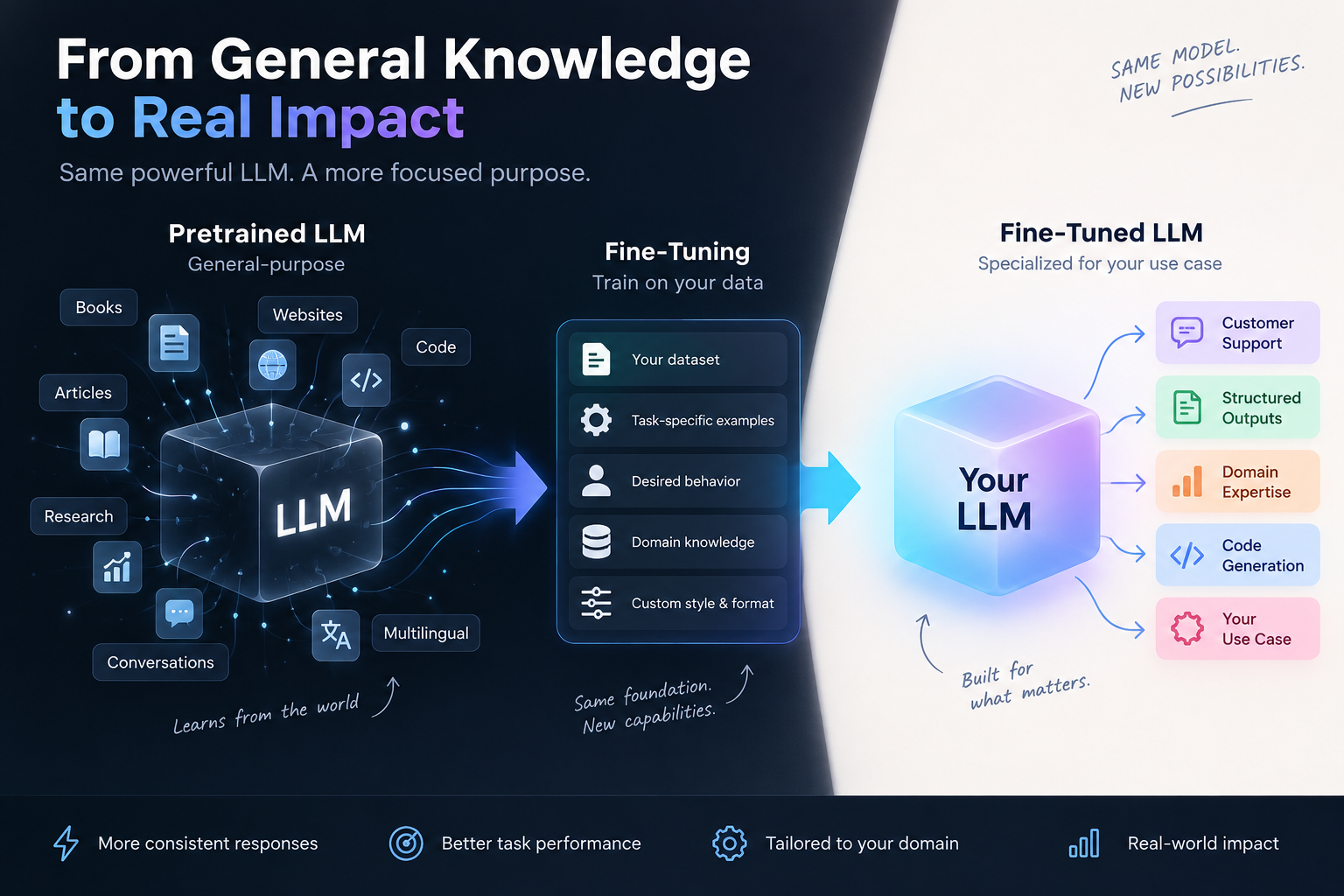
Large language models can write code, summarize documents, answer questions and analyze data with surprisingly little configuration. But a general-purpose LLM is not automatically a great model for a specific product or workflow.
If an application needs a consistent writing style, a specialized classification task or a predictable output format, the model may need to be adapted. LLM fine-tuning is one way to make that adaptation.
What is an LLM?
An LLM, or large language model, is a neural network trained on a massive collection of text, code and other data. At a high level, it learns patterns in language by predicting what should come next.
Modern LLMs can understand natural language, follow instructions, generate text, write code, summarize information, reason over problems, extract structured data and translate between languages. The important point is that the starting model is general-purpose: it has broad capabilities, but it does not know the exact behavior your application requires.
What is LLM fine-tuning?
Fine-tuning means taking an already pretrained model and training it further on a smaller, specialized dataset. You are not teaching the model language from scratch. You are teaching it how to perform a particular task or behave in a particular way.
For example, a customer-support model could learn to return a stable format such as:
{"category":"billing","priority":"high","response":"Your payment appears to have failed. Please retry the transaction."}
With carefully designed examples, the model becomes more consistent at producing this type of response.
Pretraining versus fine-tuning
Pretraining exposes a model to enormous datasets so it can learn broad language and reasoning capabilities. It is computationally expensive and results in a general-purpose LLM.
Fine-tuning happens after pretraining. You start with that existing model and train it on examples built around your requirements. The model retains much of its original capability while becoming better adapted to a task, format or style.
Why fine-tune an LLM?
Consistent behavior
Prompts can describe the desired behavior, but maintaining consistency across thousands or millions of requests can be difficult. Fine-tuning can help a model learn a response style or structure.
Specialized tasks
For support-ticket classification, a model can learn the difference between categories such as billing, technical support, refunds, accounts and sales from representative examples.
Structured outputs
When software expects fields such as intent, priority and sentiment, a model that reliably follows the required schema is easier to integrate and test.
Domain-specific language
Legal documents, financial reports, medical research and software documentation all use specialized language. Fine-tuning can improve performance on a particular domain and task, though it is not automatically the right way to add changing facts.
Fine-tuning versus RAG
RAG, or retrieval-augmented generation, retrieves relevant information at inference time and gives it to the model. This changes the context supplied to the model without changing its learned parameters.
Use RAG when:
- Your knowledge changes frequently.
- You need answers grounded in private documents.
- You need citations or source retrieval.
- You have a large knowledge base that should be updated without retraining.
Consider fine-tuning when:
- You need consistent behavior or a particular output style.
- You need specialized task performance.
- Prompting and few-shot examples are not reliable enough.
- The problem is behavior, rather than access to frequently changing facts.
The best architecture can use both: RAG supplies current knowledge, while a fine-tuned model produces a specialized response.
How fine-tuning works
- Choose a suitable base model.
- Collect representative training examples.
- Clean and format the dataset.
- Split data into training, validation and test sets.
- Fine-tune the model.
- Evaluate it against real production scenarios.
- Deploy, monitor and improve it.
The hardest part is often not the training run. It is building a dataset that represents the behavior you actually want.
Your dataset matters more than you think
More training data does not automatically mean a better model. High-quality examples are often more valuable than a huge amount of noisy data.
A useful dataset has clear labels, consistent outputs, varied examples, edge cases and realistic production scenarios. Keep evaluation examples separate from training data so the model is tested on behavior it has not simply memorized.
Parameter-efficient fine-tuning with LoRA and QLoRA
Traditional fine-tuning can require updating a huge number of model parameters. Parameter-efficient fine-tuning, or PEFT, reduces that cost.
With LoRA (Low-Rank Adaptation), the original model weights stay frozen while smaller trainable adapter layers are added to selected parts of the network. This lowers memory requirements, speeds up experimentation and produces smaller training artifacts.
QLoRA goes further by quantizing the base model while training LoRA adapters. This can reduce GPU memory requirements while retaining useful fine-tuning performance.
Common LLM fine-tuning mistakes
- Fine-tuning too early: Test better prompting, few-shot examples, structured outputs, RAG and tool calling first.
- Using poor training data: Focus on correct labels, consistent outputs, diversity and edge cases.
- Testing on training examples: Keep a separate validation and test set.
- Ignoring total cost: Account for data preparation, GPUs, storage, inference, evaluation, monitoring and retraining.
A practical customization path
Prompting → RAG → Fine-tuning → Training from scratch
Start with the simplest solution that solves the problem. Training a model from scratch is usually reserved for organizations with significant data, infrastructure and research expertise.
Final takeaway
Fine-tuning is powerful, but it is not a magic button. If the problem is knowledge retrieval, use RAG. If the problem is behavior or task specialization, fine-tuning may be the better choice. If prompting solves the problem, do not fine-tune at all.
The real skill is not knowing how to fine-tune an LLM. It is knowing when you should not.